


For families living in Ukraine, the main challenges and problems remain the same as a year ago, and unfortunately, they are the only ones demonstrating consistency in our survey. Notably, military actions and threats to life have not been the number one concern for Ukrainians for several years now. Instead the psychological exhaustion from the war, difficult economic situation, and uncertainty are the issues that worry families of children with autism the most in 2026. Across the range of responses, there are many points that deserve the attention of society as a whole—not only problems, but also things that inspire.
These conclusions are based on the results of the annual survey conducted by the “Child with Future” INGO, which took place March 30th to April 21st. As in 2025, it covered three categories of Ukrainians:
-
The first group — those who have not left Ukraine since 2022.
-
The second group — those who were forced to leave and have already returned.
-
The third group — those who left and remained abroad.
We remind our readers that this methodology was chosen to better capture the perspectives of Ukrainians who have been living for an extended period in different countries. The linguistic, and cultural environments are factors that inevitably shape their worldview and evaluations in the fifth year of the full-scale war.
The full version of the 2026 survey results, as well as all previous reports, is available on the website of the “Child with Future” INGO.
Profile of Survey Participants – 2026
This year, more than 500 Ukrainian families took part in the annual survey conducted by the “Child with Future” INGO. Approximately one in seven currently lives abroad, while the rest reside in Ukraine.
Across all three respondent groups, 80–85% live in urban areas, and 90% are parents of children with autism (the remaining respondents identified themselves as relatives, friends, or professionals).
Internally displaced person (IDP) status is held by 21% of families in the first group and 5% in the second group. In the third group, 77% have refugee status abroad.
Most respondents living in Ukraine are raising children aged 7 to 14. Slightly more than a quarter have preschool-aged children, and 15–17% have children aged 15+. In contrast, children in the third group—77% of whom have been living abroad for more than three years—are generally older, with over 70% being teenagers or adults (18+).
Key Findings of the 2026 Survey
Traditionally, our first question asked whether, in respondents’ opinion, the overall situation regarding autism in Ukraine has changed over the past year.
Overall, half of all respondents (compared to two-thirds in 2025) did not perceive any significant changes. Among those who had been abroad and returned to Ukraine, perceptions are the most optimistic: 27.3% reported improvement, while 18.2% noted deterioration. Among families who never left Ukraine, this trend remains similar, though slightly less pronounced (21.5% and 21.1%, respectively).
The greatest skepticism is observed in the third group: as last year, one-third believe that the situation has worsened. However, their responses remain relatively balanced overall (no change – 40%, improvement – 23.3%).
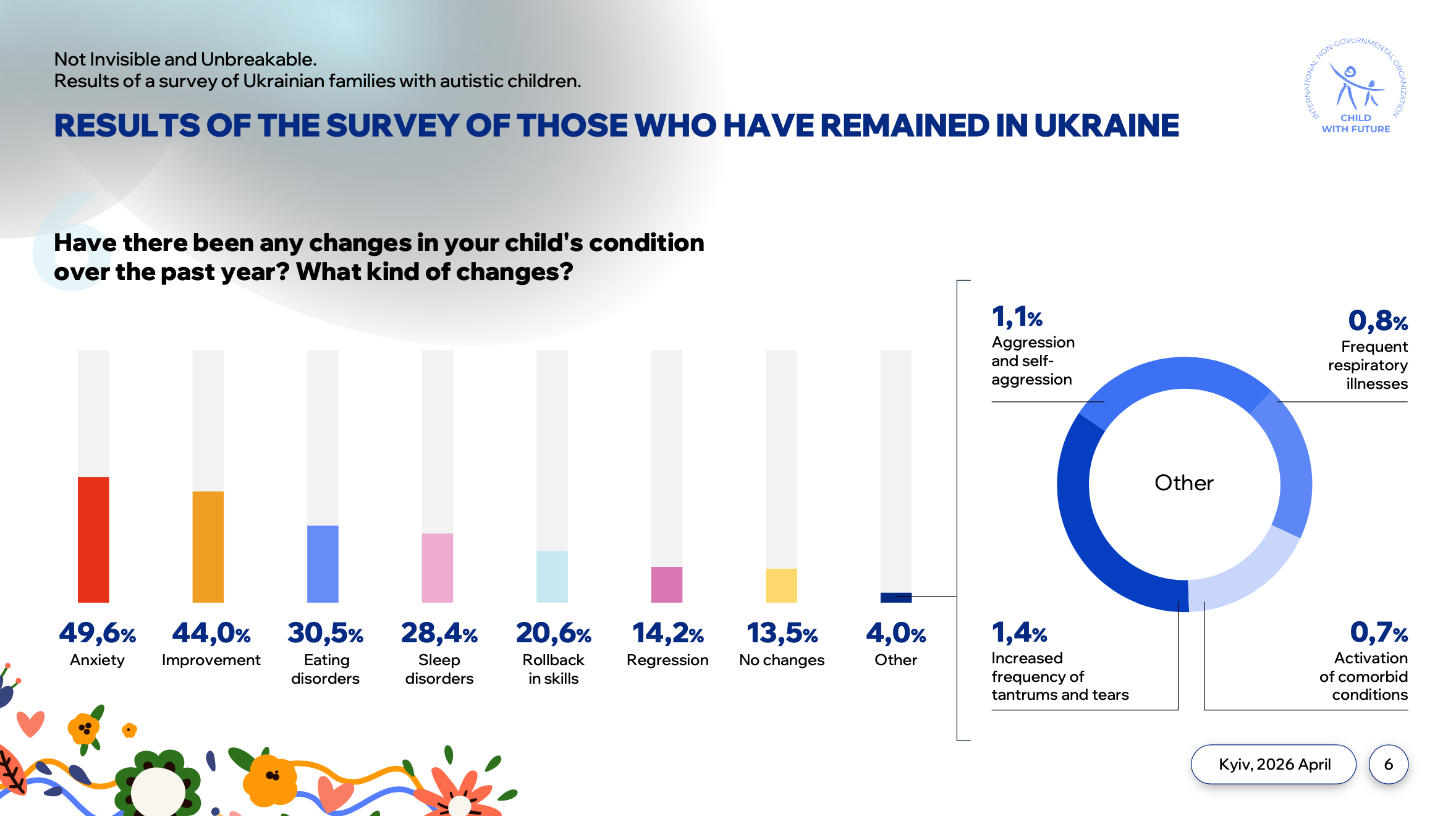
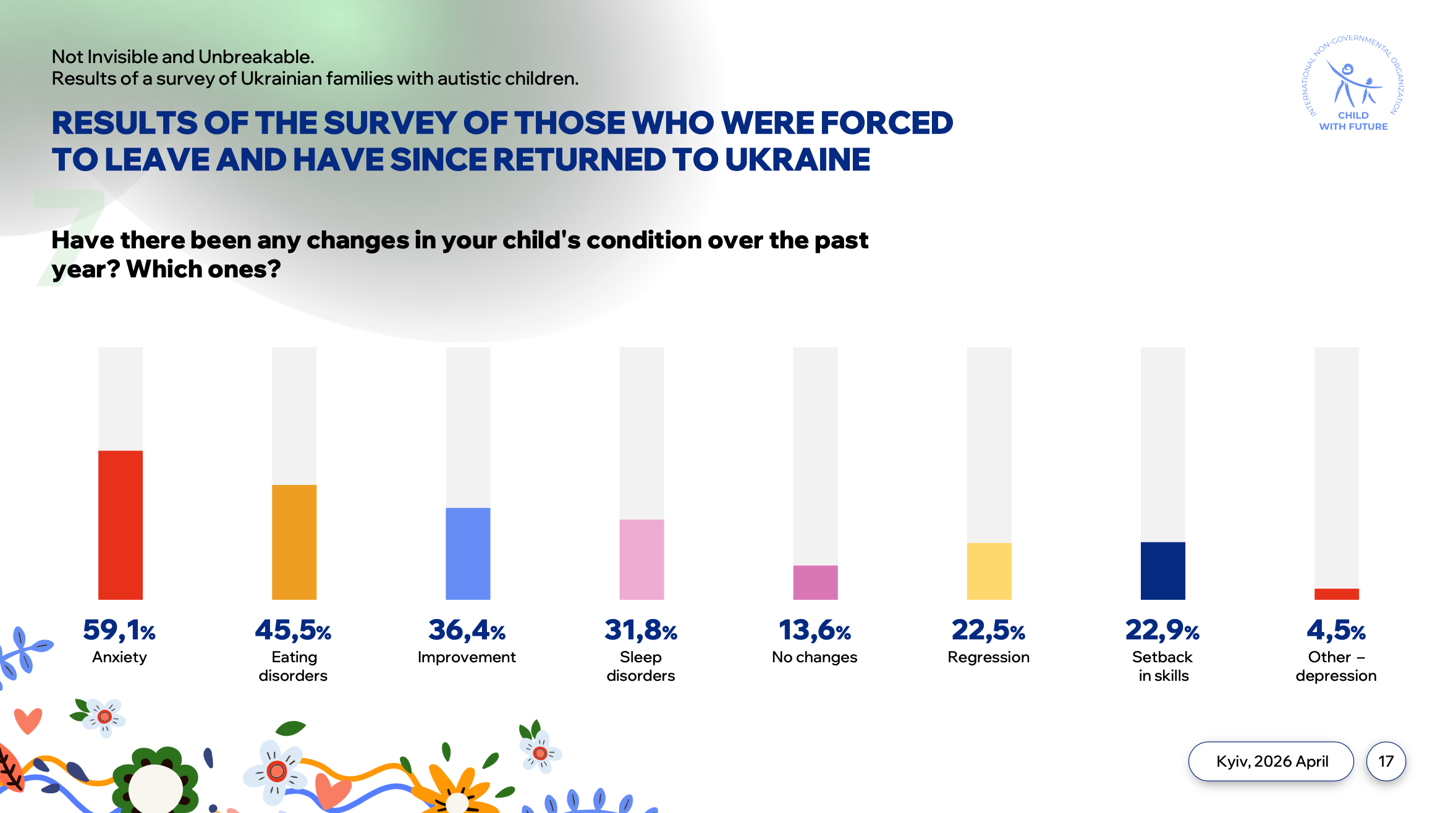
When asked about changes in their child’s condition over the past year, responses were nearly identical across all groups, regardless of place of residence. Around 40% reported progress. At the same time, every second family living in Ukraine noted high levels of anxiety in their child, along with eating and sleep disturbances. These indicators are noticeably lower in the third (abroad) group, which is not surprising.
It is worth noting that assessments by respondents in the first and second groups (both currently living in Ukraine) differ significantly. For example: anxiety levels are reported by 49.6% in the first group and 59.1% in the second; eating disturbances by 30.5% and 45.5%, respectively; regression is 14.2% and 22.7%.
As we will note later, similar differences appear in responses to other survey questions as well—this pattern has been observed before, and we will return to it.
As in the previous year, we also asked participants to identify the greatest challenges their families faced over the past year and to assess the quality of systems supporting the development of autistic children. Below, we present the TOP 5 responses for each group.
For clarity and better visualization, we compared these indicators with last year’s data and highlighted how they have changed over the past 12 months. “*” indicates factors that were not in the TOP 5 in 2025.
TOP 5 – GROUP 1:
THOSE WHO HAVE NOT LEFT UKRAINE SINCE 2022
What were the greatest challenges for your family? (%)
|
№ |
Factor |
April 2026 |
April 2025 |
Change over the year |
|
1 |
Psychological |
69,2 |
63,5 |
+ 5,7 |
|
2 |
Financial issues |
60,2 |
57,6 |
+ 2,6 |
|
3 |
Unpredictability of the situation |
57,3 |
43,7 |
+ 13,6 |
|
4 |
Military action and threat to life |
52,4 |
53,2 |
– 0,8 |
|
5 |
Shortage of services and professionals for children |
51,0 |
49,8 |
+0,2 |
In your opinion, what works well in Ukraine? (%)
|
№ |
Factor |
April 2026 |
April 2025 |
Change over the year |
|
1 |
Cost of services for autistic children |
36,0 |
28,3 |
+ 7,7 |
|
2 |
Price of medical services |
29,4 |
30,1 |
– 0,7 |
|
3 |
Professional level of specialists |
26,9 |
26,5 |
+ 0,4 |
|
4 |
Level of support from compatriots |
14,3 |
11,9 |
+ 2,4 |
|
5* |
Communication with peers and friends |
13,6 |
11,5 |
+ 2,1 |
In your opinion, what works poorly in Ukraine? (%)
|
№ |
Factor |
April 2026 |
April 2025 |
Change over the year |
|
1 |
Readiness of educational establishments to work with autistic children |
74,5 |
70,4 |
+ 4,1 |
|
2 |
Availability of infrastructure for working with autistic children (except for educational establishments) |
72,5 |
74,7 |
– 2,2 |
|
3* |
Public attitudes towards autistic children in daily life |
72,0 |
69,0 |
+ 3,0 |
|
4 |
Communication with peers and friends |
71,7 |
73,3 |
– 1,6 |
|
5 |
Municipal support |
71,3 |
92,3
|
– 21,0 |
Key Takeaways:
-
Psychological exhaustion, a difficult economic situation, and the inability to plan ahead worry most families of children with autism more than military actions or threats to life. Of course, this does not mean the latter are unimportant, but the fact remains: Ukrainians have, over time, adapted to living in conditions of war.
-
The shortage of services and specialists, the lack of preparedness of educational institutions, and insufficient infrastructure for children with autism are all interconnected—links in the same chain—and represent a systemic issue that must be addressed at the state level.
-
Respondents consistently highlight the high level of Ukrainian specialists. Our surveys indicate that this has been a stable trend since 2022. Despite all challenges, there is a strong sense of pride in their professionalism.
-
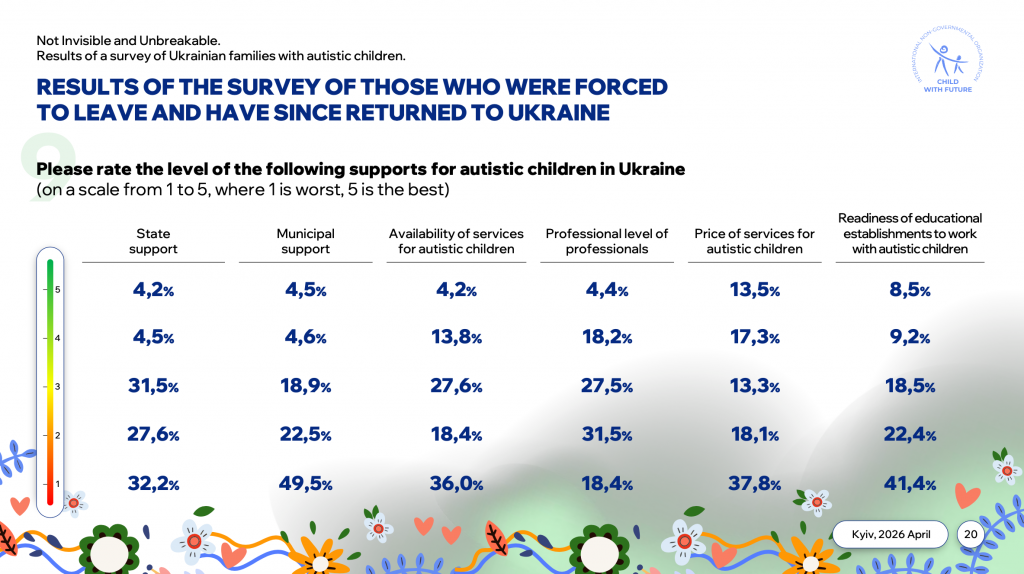
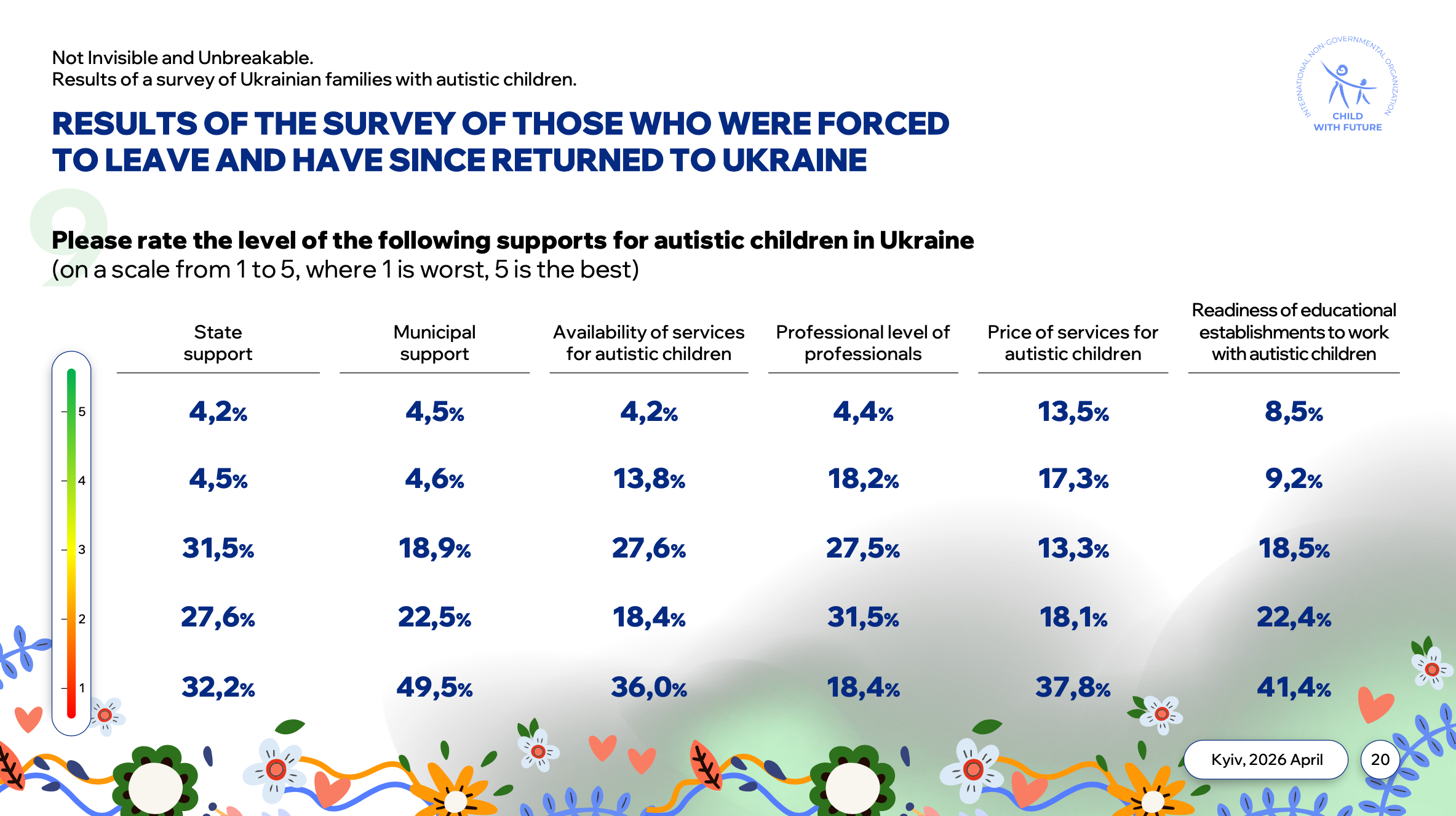
For the first time since 2022, “state support” has dropped out of the negative TOP 5. Although it still carries a high negative rating (56%), the improvement compared to the previous year (72%), along with similar trends in perceptions of municipal support, suggests a subtle shift in how people view the state—not only as an institution that is always “at fault” or “obligated to.” Against the broader backdrop of societal changes in Ukraine, this may indicate a growing civic maturity.
-
Overall, negative assessments still significantly outweigh positive ones. However, the gap between them is gradually narrowing each year—and that is a positive sign.
TOP 5 – GROUP 2:
THOSE WHO LEFT AND HAVE ALREADY RETURNED TO UKRAINE
What were the greatest challenges for your family? (%)
|
№ |
Factor |
April 2026 |
April 2025 |
Change over the year |
|
1 |
Psychological |
86,2 |
55,2 |
+ 31 |
|
2 |
Financial issues |
82,2 |
62,9 |
+ 19,3 |
|
3 |
Shortage of services and professionals for children |
77,1 |
47,5 |
+ 29,6 |
|
4 |
Unpredictability of the situation |
63,7 |
63,6 |
+ 0,1 |
|
5 |
Military action and threat to life |
55 |
48,1 |
+ 6,9 |
In your opinion, what works well in Ukraine? (%)
|
№ |
Factor |
April 2026 |
April 2025 |
Change over the year |
|
1 |
Price of services for autistic children |
30,8 |
29 |
+ 1,9 |
|
2 |
Professional level of specialists |
22,6 |
34 |
– 11,4 |
|
3* |
Public attitudes towards autistic children in daily life |
18,3 |
0 |
+ 18,3 |
|
4* |
Availability of infrastructure for working with autistic children (except for educational establishments) |
18,2 |
12,2 |
+ 6,0 |
|
5* |
Accessibility of medical services |
18.1 |
12,1 |
+ 6.0 |
In your opinion, what works poorly in Ukraine? (%)
|
№ |
Factor |
April 2026 |
April 2025 |
Change over the year |
|
1* |
Level of support from compatriots |
77,3 |
46,8 |
+ 30,5 |
|
2* |
Price of medical services |
72,9 |
32,5 |
+ 40,4 |
|
3* |
Municipal support |
72,0 |
63,3 |
+ 8,7 |
|
4 |
Status of communication with peers and friends |
68,5 |
68,9 |
– 0,4 |
|
5 |
Availability of infrastructure for working with autistic children (except for educational establishments) |
68,3 |
63,2 |
+ 5,1 |
Key Observations:
-
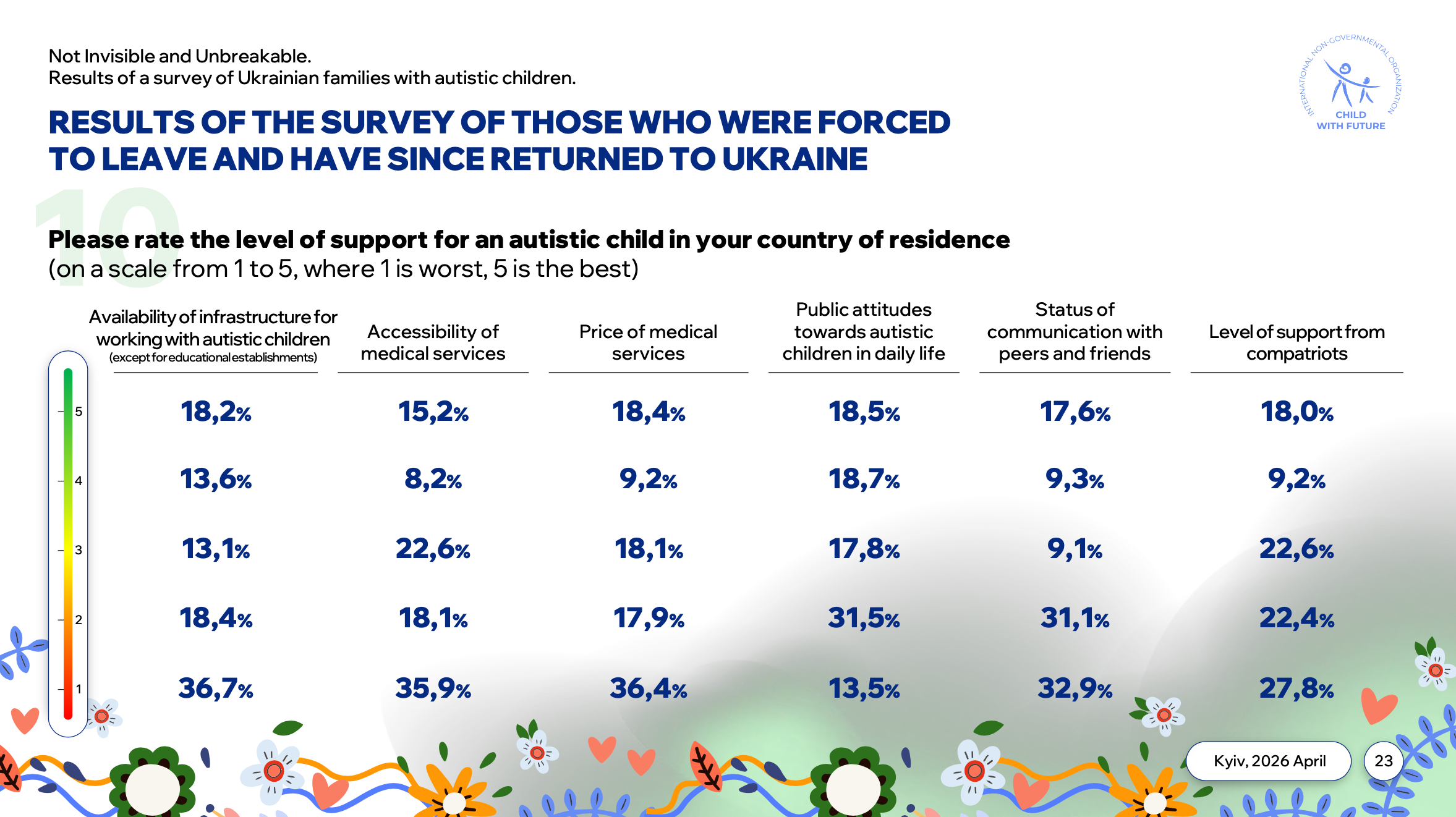
Respondents in this group demonstrate a striking shift in their evaluative judgments across a wide range of issues, with some changes exceeding 40%. This is a remarkable phenomenon that warrants careful study in the interest of the Ukrainian society as a whole. Notably, over 70% of participants in this group had stayed abroad from several months up to one year.
-
This group has the most positive outlook on the situation of autism in Ukraine (27.3%). At the same time, they report the highest indicators in questions related to their child’s condition.
-
We observe a similarly sharp shift in perceptions regarding the factor of “societal attitudes toward children with autism in everyday life” (from 0% to 18.3%), alongside a significant increase in critical views on support from fellow citizens (up by 30.5% over the year).
-
The most acute issues include: psychological and financial factors, shortage of specialists, and the cost of medical services. These are interconnected elements of a broader issue that was also strongly felt by respondents in the first group.
-
Participants in this group have also excluded “state support” from the negative TOP 5. However, their assessment of municipal support aligns closely with that of the first group: 72.0% versus 71.3%—well within the margin of statistical error.
TOP 5 – GROUP 3:
THOSE WHO LEFT AND REMAIN ABROAD
What were the greatest challenges for your family? (%)
|
№ |
Factor |
April 2026 |
April 2025 |
Change over the year |
|
1 |
Shortage of services and staff for children |
50,5 |
37,9 |
+ 12,6 |
|
2 |
Psychological |
49,5 |
49,9 |
– 0,4 |
|
3 |
Bureaucratic obstacles |
43,9 |
43,5 |
+ 0,4 |
|
4* |
Financial issues |
43,9 |
28 |
+ 15,9 |
|
5 |
Impossibility of planning |
43,4 |
45,8 |
– 2,4 |
What works well in your country of residence? (%)
|
№ |
Factor |
April 2026 |
April 2025 |
Change over the year |
|
1 |
Attitudes of the society towards autistic children in daily life |
57,1 |
44,7 |
+ 12,4 |
|
2* |
Price of services for autistic children |
46,2 |
16,6 |
+29,6 |
|
3 |
Professional level of professionals |
46,1 |
24,6 |
+ 21,5 |
|
4* |
Price of medical services |
43,9 |
17,2 |
+ 26,7 |
|
5* |
Availability of infrastructure for working with autistic children (except for educational establishments) |
40,6 |
19,4 |
+ 21,2 |
What works poorly in your country of residence? (%)
|
№ |
Factor |
April 2026 |
April 2025 |
Change over the year |
|
1* |
Level of support from compatriots |
66,1 |
62,2 |
+ 3,9 |
|
2 |
Availability of services for autistic children |
50,5 |
53,1 |
– 2,6 |
|
3 |
Level of communication with peers and friends |
50,5 |
40,2 |
+ 10,3 |
|
4 |
Price of services for autistic children |
40,1 |
54,3 |
– 14,2 |
|
5* |
Municipal support |
37,3 |
30,9 |
+ 6,4 |
Key Observations:
-
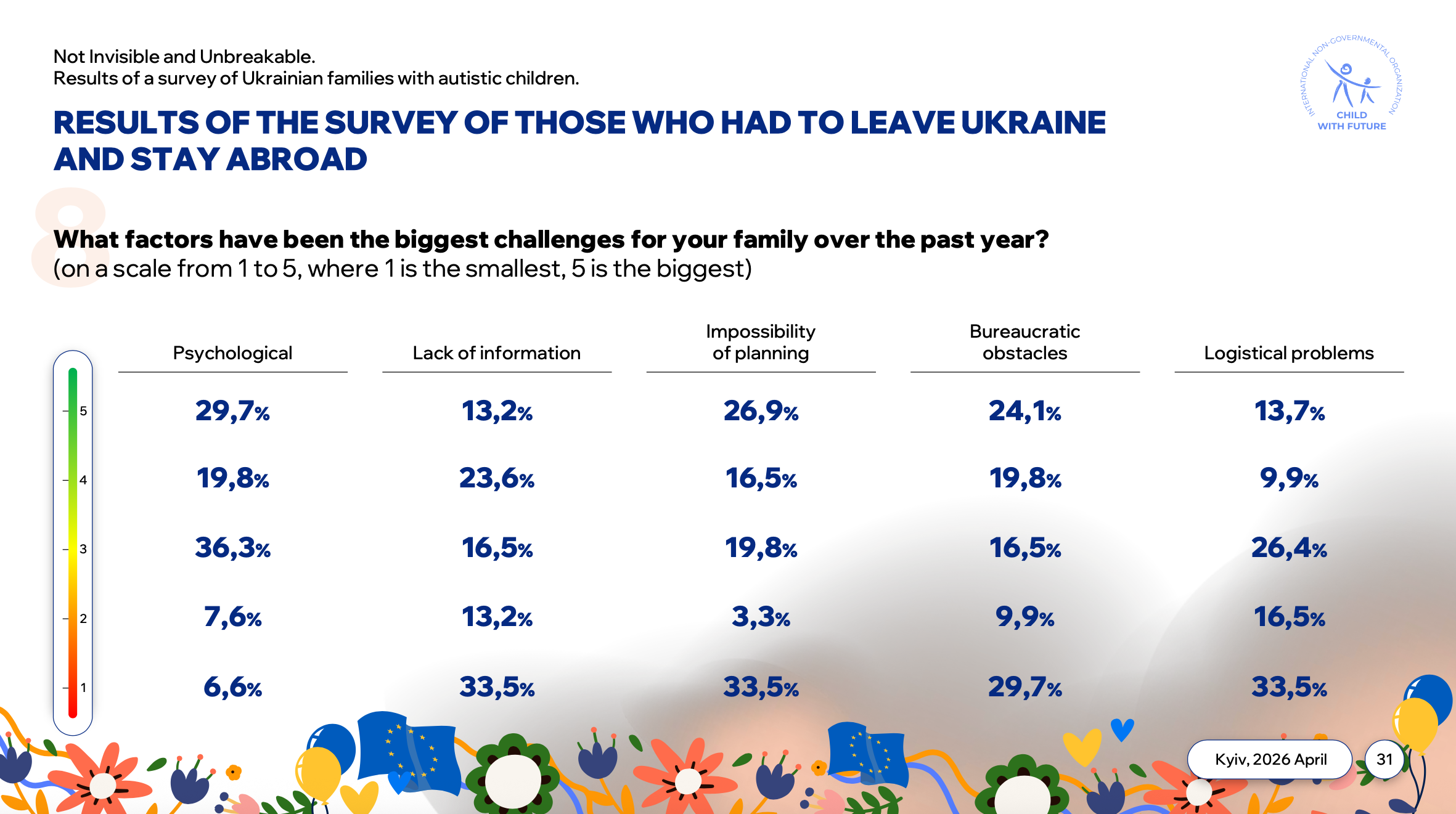
Based on the data, this is the most consistent group in terms of evaluations and judgments. 77% of the participants have been living abroad for more than three years, and the same percentage hold refugee status. Every third participant reports anxiety in their child, 40% observe progress, and 10% report regression.
-
Participants in this group live across 15 countries, most notably in Poland (27.2%), Germany (14.3%), and the United Kingdom (11.1%). Therefore, these findings are not an evaluation of any specific countries, but rather reflect the perspectives of Ukrainian families who have been living abroad for an extended period.
-
The data over the past two years suggests that many Ukrainian families have managed to join the bureaucratic systems of their host countries. This is clearly reflected in their more critical assessments of these systems—particularly regarding the cost of medical services and autism-related support. In 2025, the focus was on “accessibility” of services; now, it appears that access has largely been gained.
-
Bureaucratic barriers, shortages of services, and access to infrastructure are the traditional challenges in the EU countries and the United States. They remain in the negative trend. At the same time, the high level of acceptance in Western societies toward children with special needs continues to be viewed positively.
-
Psychological strain, financial concerns, and uncertainty remain key issues for this group as well, though they are experienced somewhat less acutely. Those concerns are matched across all three groups.
Final Block of Questions – 2026 Survey
At the end of the survey, we asked representatives of different groups several questions that relate more to the personal experiences and evaluative judgments within each group. Therefore, we do not compare them but present them separately. Although this section was relatively small, it was quite telling. We leave it without further commentary.
In your opinion, has the attitude of Ukrainian civil society toward people with developmental differences changed over the past year? (%)
|
Respondents’ perspectives |
Group 1 |
|
|
|
2026 |
2025 |
|
it has become more tolerant |
24,1 |
17,7 |
|
it has become less tolerant |
12,1 |
11,5 |
|
It has not changed |
63,8 |
70,8 |
Should government authorities and international partners of Ukraine make greater efforts today to restore infrastructure that supports people with developmental differences in Ukraine? (%)
|
Respondents’ perspectives |
Group 1 |
|
|
2026 |
2025 |
|
|
Yes, it is important |
97,9 |
95,8 |
|
No, this issue is not important |
0 |
0 |
|
It is difficult to say |
2,1 |
4,2 |
As a citizen of Ukraine, have you encountered informational or physical aggression from pro-Russian individuals in your country of residence? (%)
|
Respondents’ perspectives |
Group 2 |
Group 3 |
||
|
2026 |
2025 |
2026 |
2025 |
|
|
Yes, but these were single cases |
22,7 |
11,2 |
13,3 |
26 |
|
Yes, but these were repeated cases |
0 |
0 |
6,7 |
16 |
|
We avoided communicating with such people |
40,9 |
42,3 |
43,3 |
17,4 |
|
No, we have not had such experience |
36,4 |
46,5 |
36,7 |
41,6 |
Regarding families’ expectations for 2026 (%)
|
Category |
Group 1 |
Group 2 |
Group 3 |
|||
|
2026 |
2025 |
2026 |
2025 |
2026 |
2025 |
|
|
It will be harder |
58,9 |
41,7 |
63,6 |
31,3 |
43,3 |
25 |
|
It will be easier |
9.2 |
12,5 |
9.1 |
24,5 |
13,4 |
8,3 |
|
Not much will change |
31,9 |
45,8 |
27,3 |
44,2 |
43,3 |
66,7 |
Are you going to return to Ukraine? (%)
|
Respondents’ perspectives |
Group 3 |
|
|
2026 |
2025 |
|
|
Definitely plan to |
10 |
51 |
|
Rather plan to |
13,3 |
|
|
It is still difficult to say for sure |
50 |
33,3 |
|
Rather do not plan to |
20 |
15,7 |
|
Definitely do not plan to |
6,3 |
|
And finally, responding to the requests of our audience (which now numbers over 17,000 readers), we included a special question for all groups:
Do you agree with the following statement: “In Ukraine, special conditions should be provided for students with special needs”? (%)
|
Respondents’ perspectives |
Group 1 |
Group 2 |
Group 3 |
|
Completely agree |
92,9 |
86,4 |
93,3 |
|
It is difficult to answer/Do not know |
6,4 |
13,6 |
6,7 |
BACKGROUND INFORMATION:
This survey was conducted through an online questionnaire. More than 500 families participated, the majority of whom currently reside in Ukraine, while the rest live in EU countries, to which they were forced to relocate following Russia’s aggression in 2022.
“Child with Future” is a Ukrainian INGO that has been supporting and advocating for the rights of children with autism since 2009, and has been a board member of “Autism-Europe” since 2012.
Each year, CWF conducts surveys among individuals whose lives and professional activities are connected to autism and other developmental conditions. While these surveys are not representative in a strict sociological sense, this approach allows for the consistent collection of generalized insights, and the opportunity to share them with a broader audience.
The team of “Child with Future” sincerely thanks the governments, civil society organizations, and citizens of every country that has become a second home and a safe haven for Ukrainians fleeing the horrors of the war unleashed by Russia.
We also thank all survey participants and wish them good health, well-being, and the swift victory of Ukraine. To our allies and partners, and the entire European community that welcomed our people, we wish them strength and unity.
We hope that this information will be valuable for all those concerned with the mental health and well-being of children in Ukraine and beyond.