

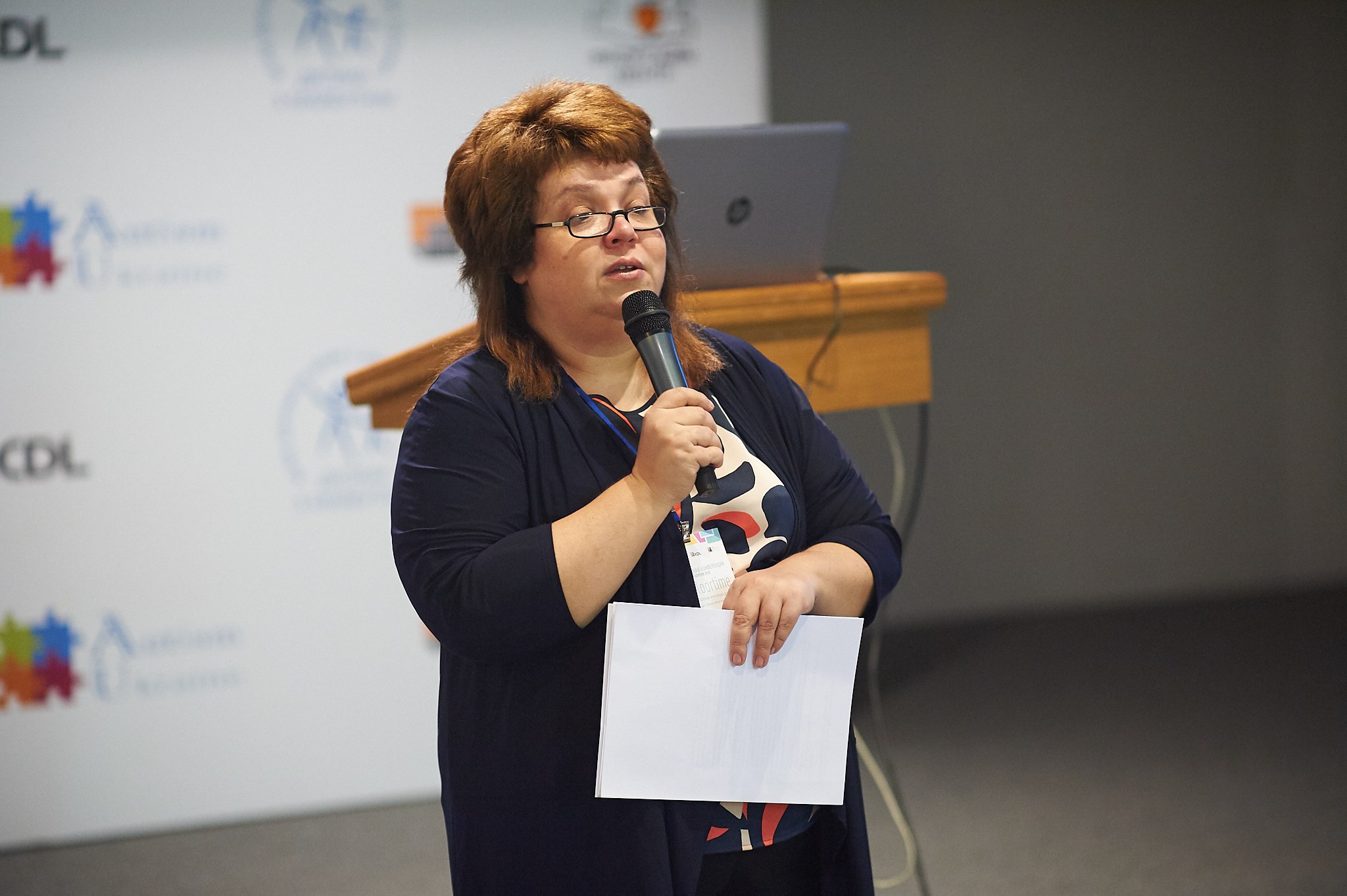
For almost four years, the full-scale war has been testing Ukrainians’ strength and humanity. This interview with Inna Sergiyenko, founder of the NGO “Child with Future” and representative of Autism Europe, is about autistic children, their families, and everyone who stands with them. We discuss the achievements and feelings of Ukraine in 2025, the role of society and state in supporting autistic children, and what 2026 may bring for our community.
Inna, let’s start with the main topic. What changes in the protection of the rights of children with special needs happened in 2025, and how did they affect the field of autism in Ukraine?
If we start with the main thing, then in 2025, the state paid much more attention to children with special needs than in previous years.
For preschool children, the role of the child’s assistant was finally regulated and clearly defined. Before, this role often looked more like a “volunteer parent.” We also finally saw changes in the approach to support teams for autistic people. The state recognized that one specialist, even a very good one, can never replace a whole team. For many years, together with friends and partners, we raised this issue in different offices. And finally, the time came to solve it.
In 2025, the Ministry of Education introduced new Guidelines for organizing education for people with special educational needs in secondary schools. They put a strong focus on safety and on preventing secondary trauma. For autistic children who often live with emotional and sensory overload and fear, this is extremely important.
Social services have also started to reform the system of financial support. In summer, some of the benefits were transferred to the Pension Fund. At first, the system was not fully ready for a new group of users. But, as the head of one local Pension Fund office explained to me, the process is now moving forward.
The Parliament has also passed a bill on increasing social support for families with children. There is hope that it will start working this year.
And of course, I cannot forget about the start of implementing ICD-11 by the Ministry of Health in 2025. This international classification will officially begin in Ukraine in 2027 and will bring a truly revolutionary change to how autism is classified. We expect it to make life much easier for many Ukrainian families. It should also finally bring order to how people with autism are identified, because the statistics that have been used by officials for many years are, to be honest, divorced from reality.
Of course, all these decisions must not remain as nice words on a screen. They must work in real life. This requires funding, training of specialists, decent salaries, services, and infrastructure. No order on paper can calm a child or give a mother peaceful sleep. We must understand that such changes take time in any country. In a country at war, bringing those laws to reality is a Herculean task.
I could talk about this for a long time. But to sum up: despite everything, Ukraine did a lot for families with special needs in the past year. These changes are not yet visible to everyone. But the most important thing is to keep going and appreciate these achievements.
As a representative of Autism Europe, you have been deeply involved in the European context for many years. What are the main trends in the EU today, and how will they influence the lives of Ukrainians?
In Europe, a quiet but deep revolution is taking place. The focus is shifting from the idea of “fixing autism” to the idea of “building quality of life.” It sounds simple, but in reality, it is a completely different philosophy.
European countries are talking more and more about autism across the whole lifespan. They honestly ask themselves: “How does a person with autism live with dignity at 7, at 17, at 40, or at 65?” It is about a lifelong journey, not just the short path of “kindergarten–school–and then somehow it will work out,” which is still very common in Ukraine.
Another very important trend is giving a real voice to autistic people themselves. Not as symbolic guests at conferences, but as equal participants in decision-making, following the principle “Nothing about us without us.” This was clearly shown at the 14th Autism Europe Congress in Ireland in September, where many important decisions were made.
One more European trend that I would really like Ukraine to join as soon as possible is the alignment of policies and standards across all EU countries. People move a lot across borders, and the support system should move with them, not disappear every time they cross into another country.
There is also a very practical trend: accessibility. Ukraine is working on this too, and I especially want to mention the role of the First Lady, Olena Zelenska. Her contribution is very visible. Accessibility is not only about ramps or larger fonts. It is about making sure a person does not fall out of life because of physical or communication barriers.
Europe has been working on this consistently for many years. And I am glad that Ukraine is increasing its pace and moving towards the big European family.
And let us remember: we are doing this while living with blackouts, lack of heating, active fighting, and constant attacks on the civilian infrastructure. This comes at a very high price. Because of russian aggression, the number of Ukrainians who have acquired disabilities is growing, and this is our reality for decades ahead. That is why these European trends are not a fashion. They are practical guidelines for how to organize life in Ukraine today and tomorrow.
That is why I never get tired of saying: if European standards build tolerance and acceptance, then we desperately need them. These are areas where nothing happens fast. But without a culture of acceptance that is built into our bones, everything else risks remaining just beautiful decorations.
A question about international activity. What event of 2025 was the most emotional for you in your organisation?
Yes, there were several. But I will tell you about one.
In September, during the Autism Europe Congress, our European partners, considering the threats from russia to Eastern EU countries, asked us: could we share our Ukrainian experience of how families with autistic children and the organizations that support them survive in wartime?
We said yes. And in a very short time, understanding how urgent it was, we prepared a special guide. It was a very honest and condensed set of recommendations based on the real experience of Ukrainian families and organizations.
In December, we presented it in Brussels to members of Autism Europe. And it felt like I was back again in February–March 2022. Our advice is not theory. It is lived experience, real mistakes, and real survival rules during russian aggression. We gave this document to our European colleagues with one wish: that they would never need to use it. Now it is being studied in different countries.
What were the biggest challenges for “Child with Future” in 2025, and were you able to overcome them?
Probably the biggest challenge was to keep stability in an unpredictable world. This sounds simple, and everyone could say the same. But it is true.
Our challenges were the same as those faced by thousands of families: constant psychological pressure, financial instability, danger to life, lack of specialists, lack of electricity, and the impossibility of making plans. We are all in the same boat.
Did we manage to overcome them? Partly, yes. Completely, of course not. We cannot stop the war or change the economy. But we can stay close to families and continue what we have been doing for more than 15 years: consult parents, inform society, make the stories of autistic people visible, and protect their rights.
And one more important thing: in such times, we must take care of people and give ourselves time to rest. When people burn out, everyone loses.
Which areas of your organization’s work in 2025 would you highlight?
Public opinion research, analytics, education, and international cooperation. All of this is public and open.
But there is one special direction that is very close to my heart. These are the projects where neurodivergent people speak for themselves. When a person speaks, abstract words disappear, and we see real individuals with their talents and dreams.
For me, a symbol of this is Maksym Brovchenko from temporarily occupied Berdiansk. I remember him as a little boy. Today he is a young man: a writer, actor, blogger, and volunteer. He speaks simply and honestly about autism, about pain, and about hope. People like him change the world more than any official documents.
I want to encourage your readers not to be silent. Do not be afraid to share your stories. Only then can you be heard and seen.
How does the war and the socio-economic situation affect Ukrainian families with autistic children?
The war affects everything. The hardest part is total instability. Today you have resources, tomorrow you do not. Today there is a specialist, tomorrow they have left or burned out. Today the school works, tomorrow it does not. And people must live, because there is no second life and no second Ukraine.
There is also exhaustion. People have been living in survival mode for years now. At some point, the body and mind simply say: enough. Our recent survey clearly shows this. The resources are running out, and the war gives us no time to recover them.
Many families with special needs children do not ask for anything extraordinary. They ask for basic things: a normal school, respect, and accessibility. They ask not for privileges, but for dignity.
And finally, what was your biggest inspiration and lesson of 2025, as a mother and as the founder of an organization?
People who do the impossible every day. Parents, defenders, doctors, teachers, energy workers. Thanks to their courage, we can live and help others.
And the main lesson is this: I want to admire not only human endurance, but a system where people do not have to survive every day. A system where support is normal, and where people with special needs are a natural part of a civilized, educated, tolerant, and strong society.
I believe this is what our strength and resilience are really about.